Strengthening sanitation in Vanuatu
Leigh van der Merwe reflects on partnering with the Ministry of Health and Engineers Without Borders Vanuatu as a Sanitation and Hygiene Mentor.
Volunteering as a family
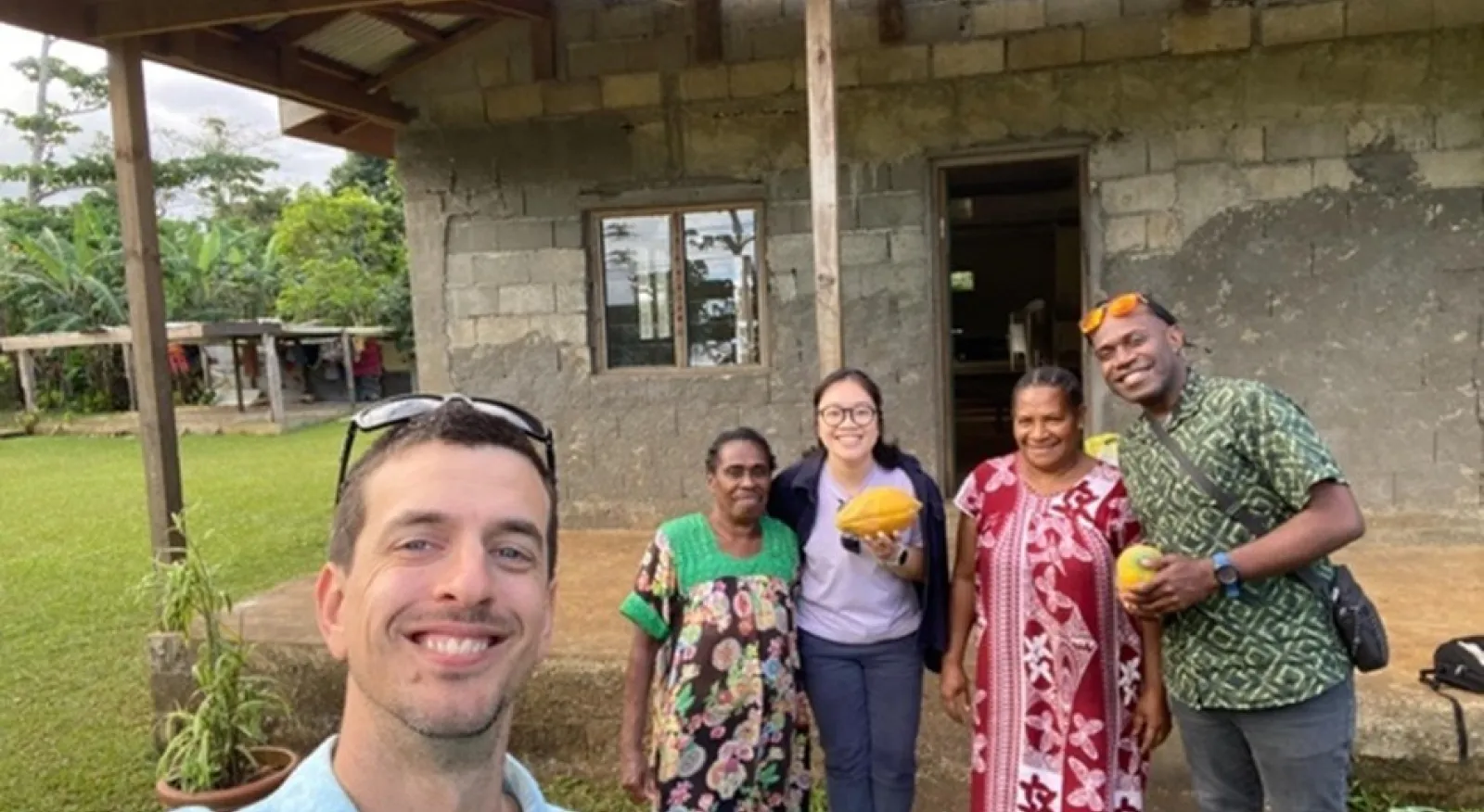
Leigh van der Merwe, along with his wife Claire and their 10-year-old son, was looking for a way to experience a new culture while sharing his professional skills. He found the perfect opportunity in Vanuatu — and their volunteer assignments exceeded every expectation.
‘The experience was all-encompassing — emotionally, spiritually, physically,’ Leigh says. ‘Every day had something, whether it was work, school, friends, expats, Ni-Vanuatu friends and colleagues, the ocean, the jungle, the food, the nakamals [traditional meeting places], the weddings, the festivals. It was a riot of different. I loved it all.’
A mechatronic engineer working in IT, Leigh supported the Ministry of Health and Engineers Without Borders Vanuatu as a Sanitation and Hygiene Mentor. Meanwhile, Claire took up an assignment as a nurse with the Ministry of Health. The couple had previously volunteered in Kiribati and loved the Pacific lifestyle, so they jumped at the chance to return to the region.
’We wanted our 10-year-old son to understand that the world is more than just his little place in Perth,’ Leigh says. ’And Claire and I wanted to contribute in a way that can utilise our skills and provide long term benefits. There was also the desire to learn how we can approach our own lives from a different perspective.’
Collaborating on local priorities
Leigh’s assignment focused on a significant national issue: sanitation. Only half of Vanuatu's population has access to basic household toilets. With 83 islands and a mix of drought-prone, flood-prone, rocky and high groundwater environments, sanitation solutions are complex. As a result, poor hygiene persists, and diarrhoea remains the leading cause of death in children under five.
The Ministry of Health and Engineers Without Borders Vanuatu developed Sanitation and Hygiene Guidelines for Challenging Environments. But a shortage of local engineers slowed implementation — a gap the Australian Volunteers Program has helped to fill through targeted engineering assignments.
‘My skills can be generalised into all sorts of activities — project and budget management, as well as any general leadership and training skills,’ Leigh says.
But his first step was to watch and listen.
‘Once I understood what they needed, I worked with my colleagues to discover gaps or issues, help them reflect on the good, bad and ugly and then get direction on how they would like to proceed … Once we had an idea, I did my best to do the busy work and take the pressure off them.’
Leigh split his time between hands-on work and capacity strengthening. He supported the roll-out of sanitation guidelines by delivering one-week training sessions, helping to develop sanitation solutions for challenging environments, and contributing to infrastructure projects such as hospital wastewater treatment rehabilitation.
He also contributed to a training-of-trainers model, empowering community leaders and village health workers to become local champions. Communities received moulds to build ventilated improved pit toilets, designed to be accessible for children and the elderly.
But his proudest achievement was witnessing the impact the training had on remote communities.
‘There were some communities that had never had any training of this type on their island. That one week [of training] can go on to affect hundreds of people for the rest of their lives. Even if they manage to take on 5% of what was taught, they are in a better place, that they can teach their children, too.’
A successful partnership
Early signs of impact are already visible: increased use of improved toilets, lower administrative burden for training, and growing demand for toilet moulds. Partners are now developing a social enterprise model to support scale-up.
But it wasn’t always smooth sailing. Leigh had to learn to think laterally and lean on his local colleagues to overcome the logistical issues that come with engineering in a Pacific island nation.
‘Logistics were a massive issue, whether it was trying to get a load of sand or blocks delivered to a house with no street name or number, or finding that the material you had paid for has been resold to another person and you need to get it on the ship that day. There was never a dull moment!’
He credits his local colleagues with helping him navigate these complexities — and so much more.
‘I learnt about the challenges they face and how they work around them to deliver a service to the people of Vanuatu. I can’t thank them enough for my grasp of Bislama [the national language] and my understanding of kastom practices, from marriage to magic. I was often in remote villages, and they guided me through everything from kava with chiefs to social protocols.’
Leigh’s supervisor at the Ministry of Health, Ms Nellie Ham, praised his contribution. ‘We do not have a lot of engineers in Vanuatu — that's our main challenge. So, having [Engineers Without Borders Vanuatu] provide us people like Leigh is so helpful,’ she says. ‘People are really wanting to build [the toilets] that we are using in the guideline, themselves. It is very encouraging to see.’
This work aligns with Australia's health security partnership with Vanuatu and supports Vanuatu's National Sustainable Development Plan 2016–2030, which prioritises improved health and universal access to sanitation as key development goals.