Taking a career from local to global
When emergency nurse Sarah arrived in Port Moresby, Papua New Guinea, she never imagined that a short volunteer stint would completely change her life.
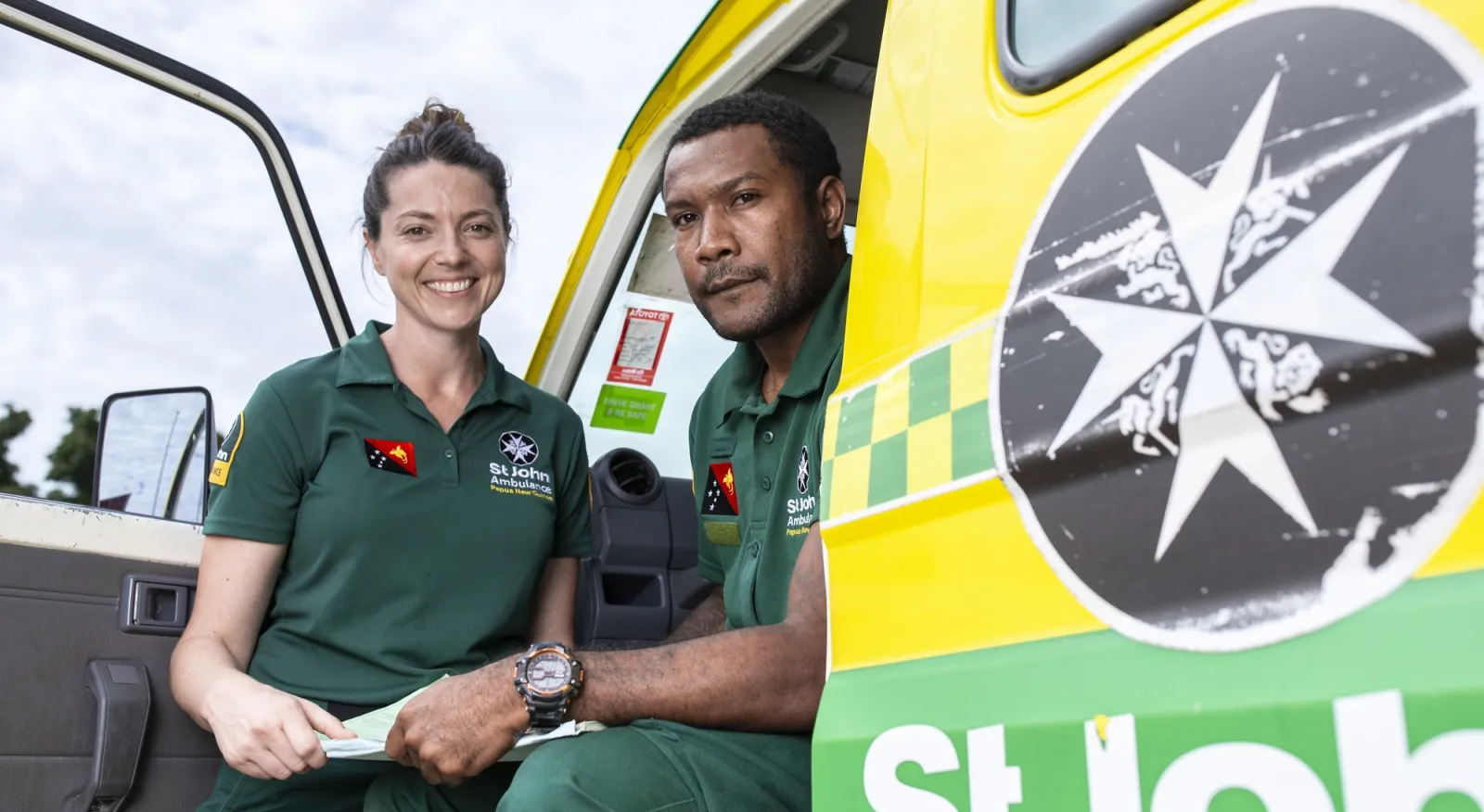
“I initially went on a self-funded volunteer placement with St John Ambulance PNG to support them during the Asia Pacific Economic Cooperation (APEC) meeting,” says Sarah Bornstein. “It was only meant to be a month, but I loved it. When I returned to Australia, I couldn’t stop thinking about it.”
That initial one-month experience sparked something bigger, and Sarah soon found out about the Australian Volunteers Program. “Self-funding made it hard to sustain long-term, so the chance to go back with the Australian Volunteers Program was ideal,” she explains. Supported by the program, Sarah returned to Port Moresby to work with St John Ambulance during a pivotal time of growth and reform. What she didn’t expect was how deeply the experience would reshape her, influencing her career and outlook on life.
“I loved being an emergency nurse, and at that point I thought I would work in the emergency department forever,” she says. “But my time with St John opened my eyes to how versatile nursing can be — it’s not just about patient care, but also roles in education, project management, and more.”
Sarah’s role with St John was broad, allowing her to engage in everything from developing standard operating procedures to training local staff. During APEC, St John received a donation of 21 ambulances, which marked the beginning of a significant expansion. “My first visit focused on preparing things for APEC. When I returned with the Australian Volunteers Program, it was about considering, ‘Ok we’ve had all these donations and hired new staff. How can we make these investments last?’”
She found it deeply rewarding to work on systems and procedures to ensure long-term sustainability. “It felt like I was stepping back from direct patient care of a few people to support the workforce level. That sense of scale and feeling like I could have a bigger impact on patients was really meaningful.”
Lessons from the long-term study
Participants who volunteered mid-career to enhance their skills reported the strongest positive impact on their professional life, benefiting greatly from the knowledge and capabilities gained during their assignment. They noted increased confidence, overall career benefits, and a strong likelihood of applying their experience at work. These volunteers also demonstrated a strong ability to sustain relationships with their host organisation and the networks developed during their assignment.*
As Sarah’s interest in workforce development grew, she began to build a professional network to support her new direction. While on assignment, she met an Australian doctor working on triage systems, and she still works with him today. “That connection really shaped what came next for me.”
What followed was a deeper dive into global health, resulting in a Master of Global Health, a series of Pacific-focused roles, and now a PhD in strengthening Pacific health systems.
“I always knew that there were clinicians doing interesting international work, but before I did the Australian Volunteers Program, I didn’t know it could be a career, or how satisfying it could be,” she says.
Now based in Darwin, Sarah credits her time with the Australian Volunteers Program as a turning point in her life. “It’s played a deep role in everything I’ve done since, and it’s given me the confidence to make a career out of this.”
While Sarah was in the midst of her volunteer assignment, the future benefits weren’t always clear. She faced the realities of life in Port Moresby including limited mobility, security risks and a fragile healthcare system. However, she ultimately found value in overcoming each of these obstacles.
“We were restricted in what we were allowed to do and where we could go. We needed security to go to the supermarket, so it’s not easy, but being there with other volunteers made all the difference. We supported each other a lot.”
Sarah found the reality of the healthcare environment in PNG intense and often heartbreaking. “There were a lot of sad cases… In Australia, patients would have had access to more resources and may have very different outcomes,” she reflects. “But the local team was so eager, willing and keen to learn. In Australia, we sometimes take it for granted. When you’re told to attend an education session, there are eye rolls. But in PNG, it’s, ‘Can I come as well? How do I sign up?’ I really loved their enthusiasm.”
For Sarah, the most valuable lessons came from managing challenging situations. “I learnt when to speak, when to stay quiet, when to get involved, and when to step back. Those are far more useful skills than any clinical skills that I’ve ever had, and I think they’re often undervalued.”
Her advice to others considering a volunteer assignment? “Go for it! It’ll change your life,” she says. “For some, it’s a short experience that creates amazing memories. For others, it can change everything and lead you down a totally different path. Either way, it’s a truly incredible experience.”
Sarah participated in a long-term study by the University of Technology Sydney (UTS) to understand how volunteering shapes people personally, professionally and culturally. Find out more about the benefits of volunteering.
*Fee, A & Lizier, A. (2024). Longitudinal Study of Australian Volunteers (2019-26): Interim Report (July 2024) p 7.