Early career volunteering creates long-term impact
Liz’s volunteer experience had a profound impact on her professional direction, particularly because it occurred early in her career.
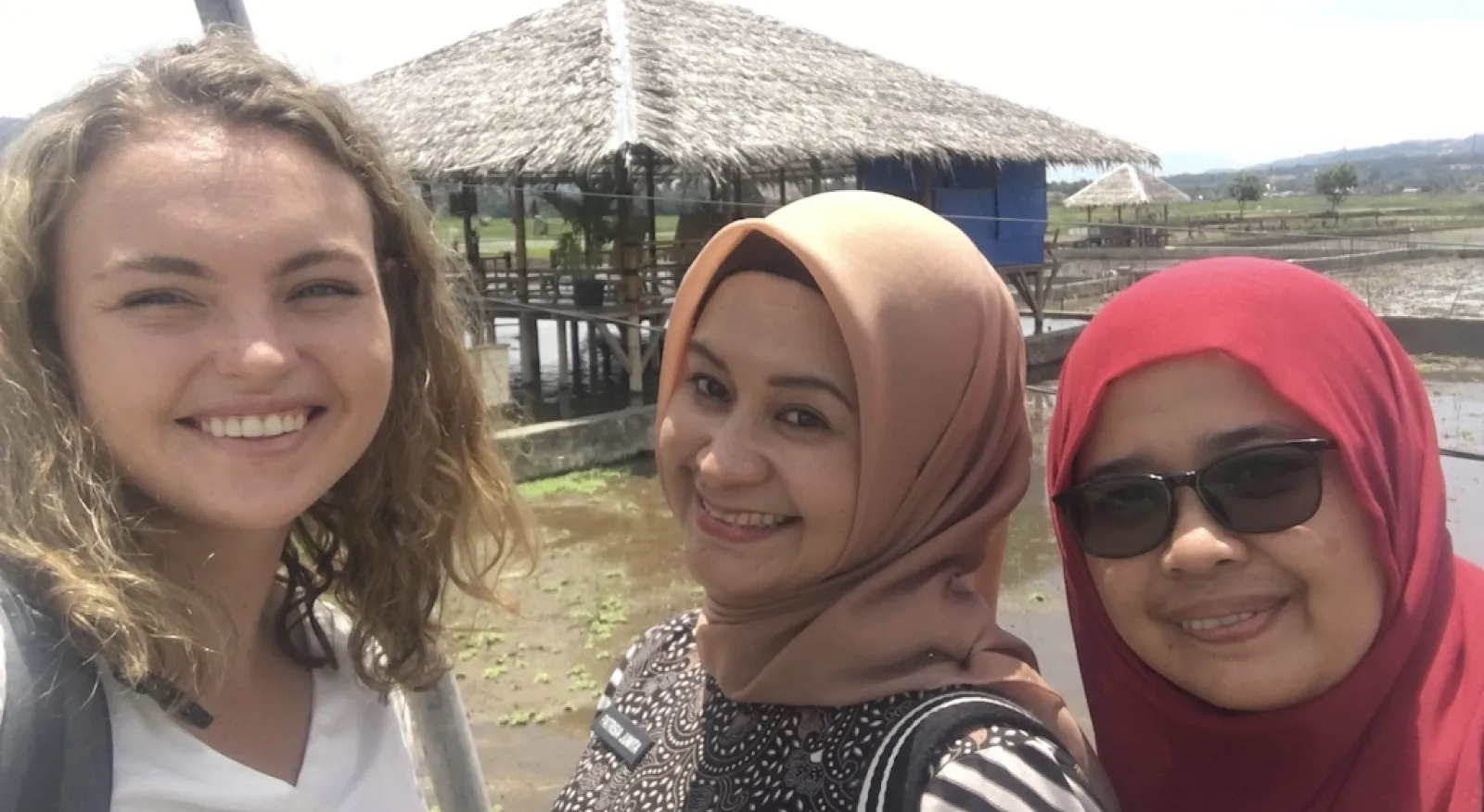
Liz Moss set off for her assignment in West Sumatra at 25, having spent several years working, studying and travelling overseas. Her assignment was as a Business Development Mentor with LP2M, an organisation supporting women through microfinance, education, disaster preparedness, and entrepreneurial training. She helped to strengthen small-scale, women-led business networks and develop LP2M’s fundraising unit.
During Liz's assignment, LP2M established Limpapeh Handmade — an ethical brand using naturally-dyed fabrics and traditional Minang weaving techniques to create products that fund LP2M’s community work.
“My focus was on bringing the brand online and establishing partnerships for sales and development initiatives, including a short documentary and community-led workshops,” Liz explains.
One of the key lessons Liz took from her experience was the importance of listening, building trust, and forming relationships. “Often, the most valuable thing you can do is back your host organisation and community to drive the work — that’s where the real impact and learning comes from,” she says.
“I think what makes a great assignment is when the volunteer finds ways to contribute to momentum that already exists — supporting the host organisation’s goals, not leading them.”
Lessons from the long-term study of volunteers
International volunteering can help people develop their career focus. A large proportion of volunteers who wanted to make a more positive social or environmental impact through their work found a new position, organisation or sector that allowed them to do so after their volunteer assignment.*
While Liz had plenty of opportunities to build her professional skills, there was a lot of fun to be had along the way, too. She chose to volunteer in a remote area because she wanted to be fully immersed in the culture and language. “It was social, lively, and full of everyday experiences that helped me connect with people and learn the language much faster,” she says. “I surfed most days, travelled, went to weddings, birthdays, dinners, and made great friends. I’m still in touch with friends from Sumatra.”
Of course, there were challenges to face as well, including adjusting to the local culture, which was quite conservative. “Without an expat community, it could feel isolating at times — especially when cultural practices felt unfamiliar or when English wasn’t commonly used. But I found that embracing it, learning quickly, and following local norms made a huge difference. You have to be openminded — you’re not there to change anything through imposition. I also leaned on my cohort of volunteers — we became close friends even if we weren’t in the same city.”
Since returning to Australia, Liz has steadily built on her skills and experience through a Masters in Disaster Management, with a focus on resilience through community-building and cultural systems in West Sumatra. She now chairs DisasterWISE, a national network supporting community-led disaster resilience.
She also joined a social enterprise development in Western Australia, which directly built from her assignment and led to her supporting Loop Upcycling, a social enterprise for which she is now a board member.
For the last two years, Liz has been leading the Pilbara Innovation Partnership, a public–private investment into community-led research and projects across the pastoral industry in northern Western Australia. She credits her volunteer experience with helping her develop a lot of the skills she relies on to be successful at work.
“Volunteering helped me clarify what kind of work I wanted to do and gave me practical skills, experience and confidence that I still use. It also shifted how I think about leadership and contribution,” she says. “That experience gave me a foundation for the kind of complex, long-term, community-led work I now do in remote parts of Australia. I honestly don’t think I’d be doing this work if I hadn’t volunteered. It also taught me how to adapt quickly, work in uncertainty, and navigate cultural complexity — skills I rely on every day.”
Liz participated in a long-term study by the University of Technology Sydney (UTS) to understand how volunteering shapes people personally, professionally and culturally. Find out more about the benefits of volunteering.
* Fee, A & Lizier, A. (2024). Longitudinal Study of Australian Volunteers (2019-26): Interim Report (July 2024)